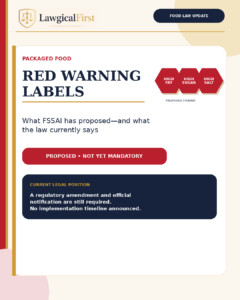
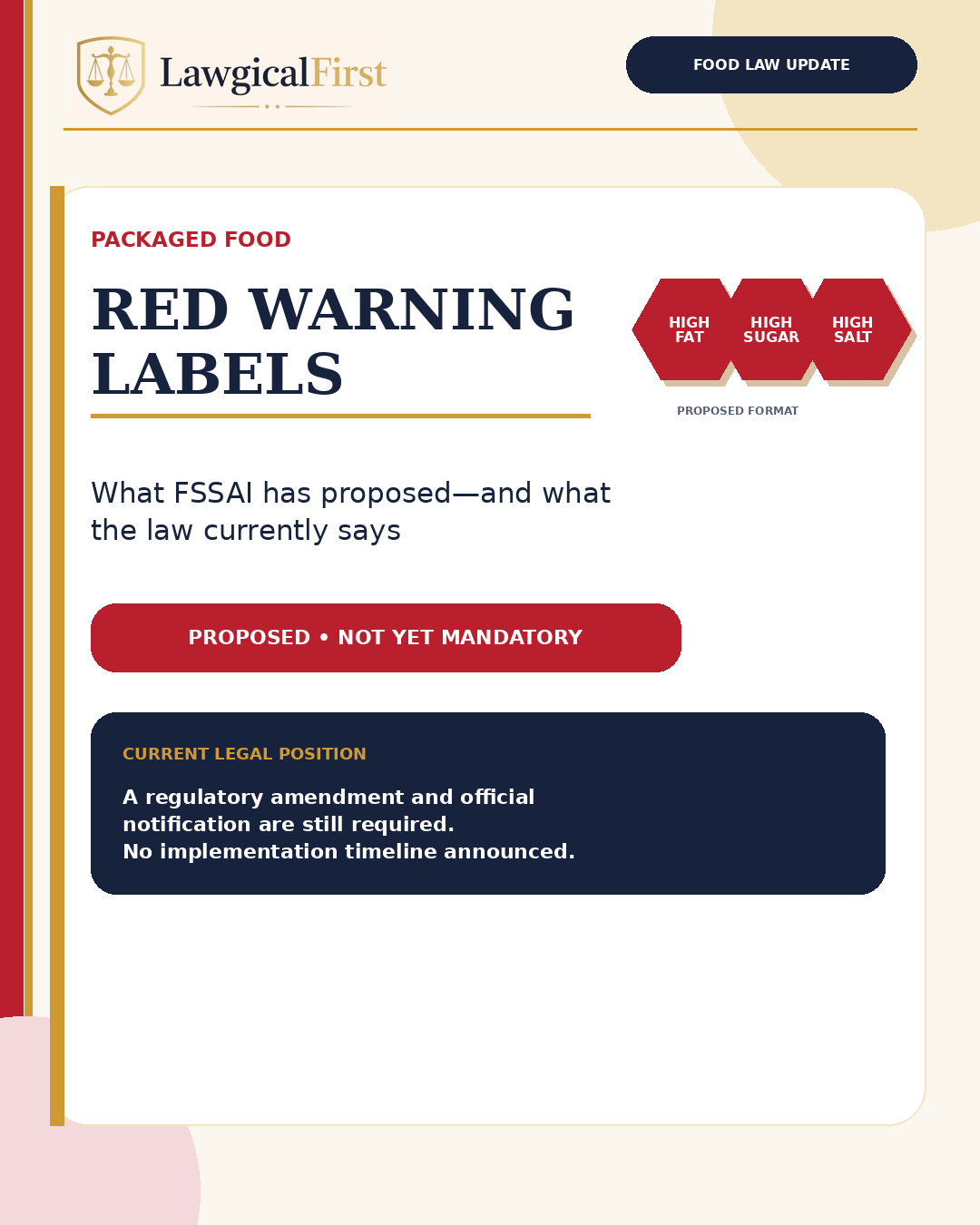
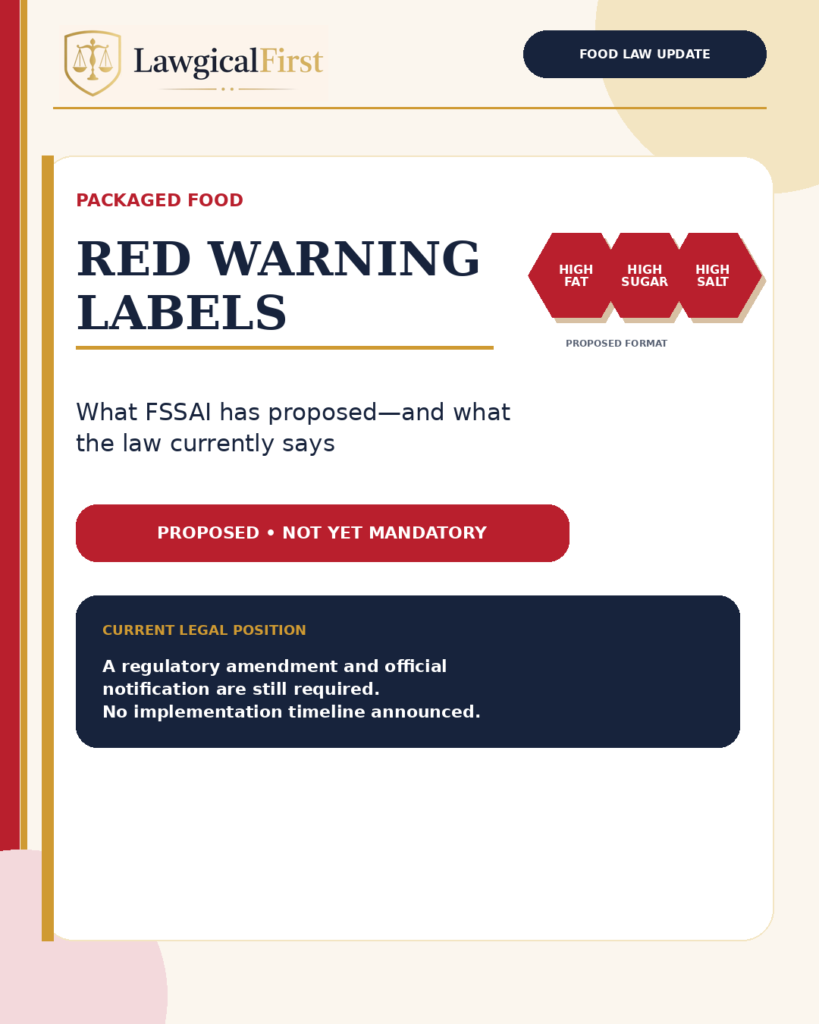
Packaged foods in India could in future carry prominent red warning labels indicating that they are high in fat, sugar or salt. The Food Safety and Standards Authority of India (“FSSAI”) has placed a proposal before the Supreme Court to introduce front-of-pack nutrition warnings on specified packaged food products.
However, these warning labels have only been proposed. They are not currently mandatory, and no official implementation timeline has been announced.
Why has FSSAI proposed these warning labels?
The proposal has emerged during proceedings before the Supreme Court in 3S and Our Health Society v. Union of India & Anr., being considered in Miscellaneous Application No. 1177 of 2025 in Writ Petition (Civil) No. 437 of 2024.
The petitioner has sought clear, interpretive front-of-pack warnings for packaged foods containing high levels of sugar, salt and saturated fat.
On 10 February 2026, the Supreme Court observed that the public-interest proceedings raised an important issue concerning citizens’ right to health. The Court asked FSSAI to consider the petitioner’s suggestion that pre-packaged food products should carry front-of-package warnings and directed the Authority to revert within four weeks.
During the subsequent hearing on 13 August 2026, the Supreme Court expressed concern about the delay. It asked the Union Government, in consultation with experts, to decide the visual appearance of the front-of-package labelling system and granted the Government two weeks to place its final decision on record.
FSSAI subsequently filed a compliance affidavit on 28 August 2026, setting out its proposed warning-label framework.
The proposal is intended to provide consumers with a simple, prominent and easily understandable warning that a product contains high levels of specified nutrients of concern. It is particularly aimed at supporting informed food choices for children and other vulnerable groups.
What type of warning label has been proposed?
FSSAI has proposed a prominent red-coloured hexagonal warning symbol on the front of applicable packaged food products.
Depending on the product’s nutrient content, the symbol may carry one or more of the following declarations:
Where a product exceeds the applicable threshold for more than one nutrient, the relevant warnings may be displayed together.
The proposed warning text would appear in a font size one point larger than the font used in the nutrition information table on the back of the package.
How would the two-phase system operate?
FSSAI has proposed that the warning-label system be implemented in two phases.
Phase I
During the first phase, the warning would apply to products that are high in any two or more of the following specified nutrients:
Specified sweetened beverages are also proposed to be covered and may carry the declaration “HIGHLY SWEETENED BEVERAGE.”
Phase II
During the second phase, the warning requirement would be extended to products that are high in even one of the specified nutrients.
According to FSSAI, the phased approach is intended to facilitate consumer acceptability and provide the food industry adequate time to reformulate affected products.
No commencement date or period for either phase has presently been announced.
How would “high” fat, sugar or salt be determined?
The compliance affidavit states that the proposed classification would be based on the nutrient-of-concern thresholds specified under the Dietary Guidelines for Indians, 2024, issued by the Indian Council of Medical Research–National Institute of Nutrition (“ICMR–NIN”).
This reference must be understood carefully. The ICMR–NIN document contains dietary and nutritional guidance. It is not, by itself, an enforceable food-labelling regulation.
For legal enforcement, the applicable thresholds, product categories, method of calculation, warning format, exemptions and compliance requirements would need to be expressly incorporated into the relevant FSSAI regulations through the prescribed regulatory process.
Accordingly, the dietary values mentioned in the ICMR–NIN guidelines should not automatically be presented as final statutory product-labelling cut-offs unless and until FSSAI formally adopts and notifies them for that purpose.
Which products are proposed to be exempt?
The following categories are proposed to be exempt from the front-of-pack warning requirement:
The affidavit reportedly gives the following examples of inherently rich products:
These proposed exemptions would apply only to the front-of-pack warning requirement. Such products would continue to remain subject to all other applicable requirements under the Food Safety and Standards Act, 2006, and the relevant food-safety and labelling regulations.
Are the red warning labels already mandatory?
No.
FSSAI’s compliance affidavit contains a regulatory proposal, not a final notified regulation. Filing the proposal before the Supreme Court does not, by itself, create an enforceable labelling obligation for food businesses.
Before the proposed warnings can become legally mandatory, the relevant Food Safety and Standards regulations would need to be amended through the prescribed regulatory process.
Under Section 92 of the Food Safety and Standards Act, 2006, regulations are made by the Food Authority with the previous approval of the Central Government and after previous publication. The process would ordinarily involve:
As of 7 September 2026, no final notification making the proposed red-hexagon warning system mandatory has been identified, and no official implementation date has been announced.
The existing Food Safety and Standards (Labelling and Display) Regulations, 2020, together with their notified amendments, therefore continue to govern the current labelling obligations of food businesses.
Why does this proposal matter?
Most consumers do not have the time or technical knowledge required to interpret detailed nutrition tables while purchasing packaged food. A prominent warning on the front of a package may enable consumers to identify products high in specified nutrients more quickly.
The issue also has a constitutional dimension. In its consideration of the matter, the Supreme Court referred to the right to health flowing from Article 21 of the Constitution and the State’s duty to improve public health under Article 47.
The Court also emphasised that front-of-package labelling should provide clarity and enable consumers—particularly children and other vulnerable groups—to make informed purchasing decisions.
At the same time, legal accuracy remains important. A warning-label proposal, even when filed before the Supreme Court, should not be represented as an existing statutory mandate until the necessary regulations have been formally amended, approved and notified.
The proposed warnings would also identify products containing high levels of specified nutrients; they should not automatically be interpreted as declaring a product unsafe, prohibited or unfit for consumption.
What happens next?
According to the Supreme Court’s advance cause list, the matter is tentatively listed for further consideration on 10 September 2026.
The Court may consider FSSAI’s proposal, the Union Government’s final position and any response placed on record by the petitioner. The proposed design, nutrient thresholds, exemptions, implementation phases and compliance periods may change during the judicial and regulatory process.
Consumers and food businesses should therefore rely on final FSSAI notifications and Gazette publications before treating any part of the proposed framework as legally binding.
Sources
Disclaimer: This article is intended solely for general legal awareness and information. It does not constitute legal, regulatory, nutritional or professional advice. Readers should refer to final statutory notifications and obtain appropriate professional advice for product-specific compliance.